
In the Land of Gods & Monsters, Nolan Speaks the Language of Consequences.
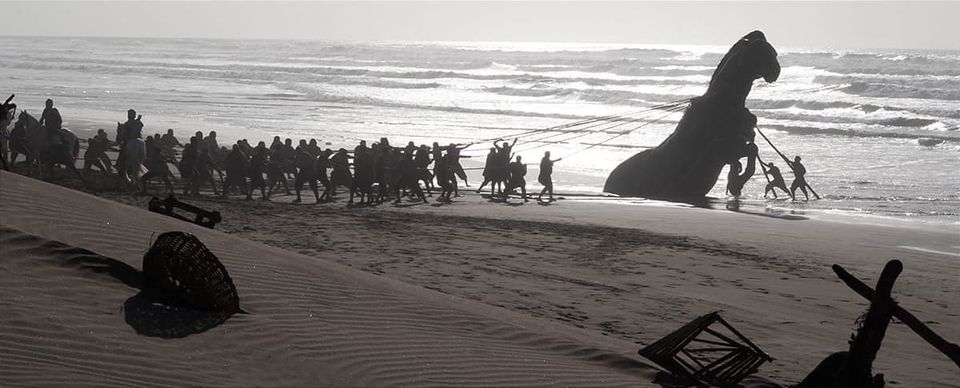
Odysseus often asks, “Why can’t gods speak in ways we understand?” I see this question being asked of Christopher Nolan, or rather his direction of the film, by half the people who have watched The Odyssey so far. The other half are barking back that he couldn't be more literal. Let’s dive into the divide.
While many of the audience contemplate the battle between Nolan’s accuracy to Homer and his own artistic adaptation, I am still reeling from heart palpitations leading up to the battle of Troy.
The trick of the Trojan Horse is a story so well-known throughout history that it is easily translated into memes at this point, but seeing it play out is always a delight. So color me tickled as soon as Odysseus and his soldiers started to climb out and start their attack. A stealthy moment slowly and deliberately turned into a heart-racing, forward-leaning, armrest-gripping sequence that was so suspenseful I wanted to scream, in IMAX. As if triggering a new sense, I noticed the score was so perfectly tantalizing that I could not at first tell whether it was the sound design or the sound of my arrhythmia. A nod to the film’s composer, Ludwig Göransson.
While the actual battle once Agamemnon shows up is not memorable enough to mention (I actually can’t even remember if it happened as I’m writing this), every second leading up to it was worth every near-stroke. If anything, the siege of Troy was never the central point; it was told in glimpses, through Odysseus’s attempt to recount his memories. Troy was a flashback to reference guilt throughout the film, among other things, but never a climax.
This is when I realized, Nolan’s mastery is in transitions. He hits the mark on scenes leading up to the climaxes, and the wreckages after them. A man so skilled at stories full of twists and turns that destinations hardly matter because the ride there was the thrill of it all. A great deal of this film lives in the in-betweens. Am I saying this is how a movie, particularly one adapting the greatest epic of Western civilization, should be directed? No, but I’m not mad at it either.
The attack on Troy was not the last time I caught this glint in Nolan’s vision. After Odysseus and his crew have finished the decade-long war and embark on their return to Ithaca, rough waters and depleting resources find them anchoring down at various islands. The story of how Troy was deceptively taken has spread and thus, the long string of consequential calamities ensues on the victors.
On the island of the Laestrygonians (the scary, armored giants), the men are cautiously walking through a forest, hoping for hospitality. In another scene-in-between-scenes, Nolan shows a great example of the calm before a storm. A seemingly tranquil ambiance is undercut so finely with the eerie sense of a looming threat that you feel as shocked by the lack of hospitality as Odysseus. The sight of the giants slowly breaking through the forest fog is so brooding I had my head in my hands. This was also one of the many moments I thanked myself for snagging IMAX tickets ahead of time.
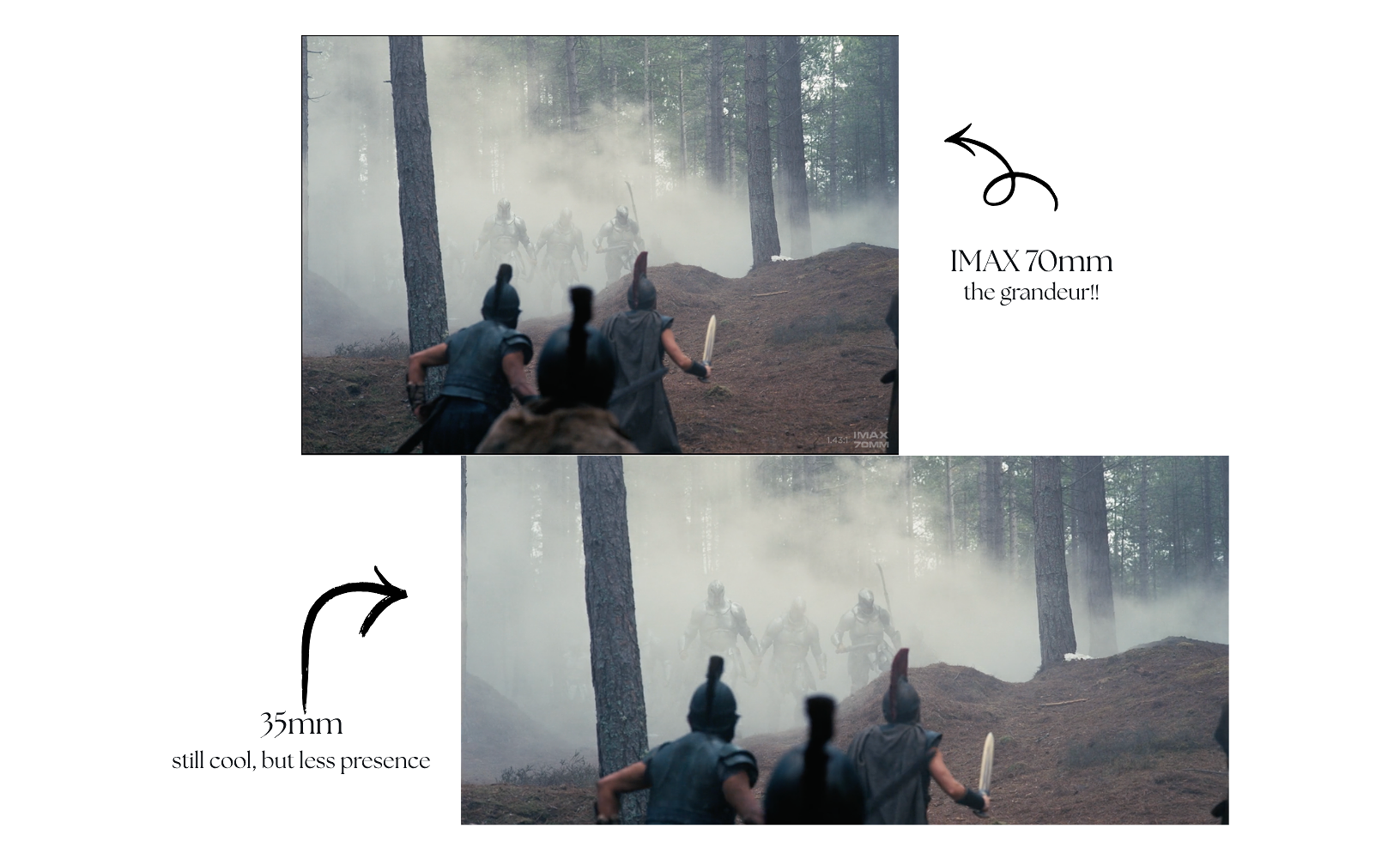
The magnitude of this scene alone was so incredible that I wanted to run back to their ship with them and sail away. All of the juice is in the approach of the giants. However, watching the sword-slashing and the drowning of whole boatloads of unlucky men… did not strike me as much. The scene was done once Odysseus made it to his ship.
All of this got me thinking, Nolan has always excelled in action, suspense, and wreckage. It is the reason he is the IMAX whisperer and naturally the one to make an entire film on IMAX cameras for the first time in history. However, this is different from movies like The Dark Knight, which is renowned for its fast, rambunctious, cinematic scenes like the Joker’s introduction, or even Inception, which relies heavily on the visual illusions happening in real time. Rather, The Odyssey is a drama recounted. When you’re sat around the fire by an elder, the message you are left with is hardly the grandiose actions of a faceless hero, but instead the impact of consequences and lessons learned that circle around in your head as the smoke clears out.
That emphasis on build-up and breakdown is the language Nolan is speaking in this adaptation. He marries the screenplay with direction to tell a story of consequences.
Consequences, and rage.
The entirety of The Odyssey is pining for relief from this war that doesn’t even take place on screen. We did not need another movie with a 10-minute battle scene, we already got it. Troy was a betrayal not only to an unsuspecting city and Odysseus himself, but to civilization thereafter. It is this lingering consequence that enrages every character we meet.
Penelope, the forlorn wife burdened with a throne she keeps warm for her king’s return.
Telemachus, the heir-in-waiting, searching for a father he has only heard about in stories.
Sinon, a boy too young, robbed of the honor he promised his family.
And on and on.
The overarching sense of rage in this film is like a tension held together for 3 hours, strung as skillfully as Odysseus’s bow. So by skipping over big, blockbuster sequences and iterating personal torment, The Odyssey is underlining the subtext of the original poem.
Now that I've analyzed the thick of it, I do want to highlight the highs and the lows.
The exposition didn’t quite land, with Odysseus’s Lessons Learned monologue ending like a conclusion paragraph you submit at 11:59. Although, what did we expect from the man who gave us, “You either die a hero or live long enough to see yourself become the villain?” In this case, you live long enough to become the Sea People.
The way it was delivered though? Odysseus and Penelope riding off into the sunset, a scene fully actualized after flashing it as a quick, foreshadowed glimpse in the first act of the movie: classic Nolan touch. I knew it was going to come back around when I first saw it. He loves his full circle moments.
While the dialogue was an equal mix of hits and misses, the actors really did their best to soar above some cringe-worthy lines. Himesh Patel and Matt Damon had such good chemistry, I felt like I was at home on that ship. I’ve never personally had to defend a throne while my husband went off to war, but I could have cried along with Anne Hathaway in some of those scenes. It is worth noting in a script when a story passed down from Ancient Greek can still elicit empathy for mythological characters.
Other times, I felt Damon fell flat. As Odysseus descended from the Great Warrior to just a man, I was hoping to see more visible unraveling. I’m afraid the only hint of that came from the dubious looks his crew gave throughout the journey. You can read Homer’s recount, you can psychoanalyze Odysseus through educated assumptions of grief, but I could not tell you why exactly Odysseus shoots the arrow into the Cyclops after they’ve left the cage, and I believe that is due to Damon’s lack of expression. One night he reasons, “Do you talk to ants?” and the next day he wounds the owner of a home he invaded. There should have been more pause.
A pause over Travis Scott’s presence in the film was understandable at first, but seeing how he fit — and his ultimate significance? Brilliant.
The soundtrack? Stellar from the creation to the delivery. As Eliana Dockterman writes in Time, “Nolan instructed Göransson not to use an orchestra in the score, if only to subvert expectations for a swords-and-sandals film. ‘It’s not like the orchestra existed back then,’ says Göransson. ‘It was a challenge and also an opening to try to make something unique.’ Instead, Göransson rented 35 bronze gongs of varying sizes, experimented, recorded them with synths, and began sending the director songs.”
From using replicas of ancient Greek instruments, to creating silencing technology to assist IMAX cameras in filming scenes they never have before, The Odyssey is an accomplishment I couldn’t have imagined by anyone else than the auteur Christopher Nolan.
Member discussion